
Commercial electrical testing in Leeds
Fixed-wire testing, PAT testing and statutory compliance inspections for commercial premises. Tested to BS 7671 by NICEIC-approved engineers, reports in 48 hours.
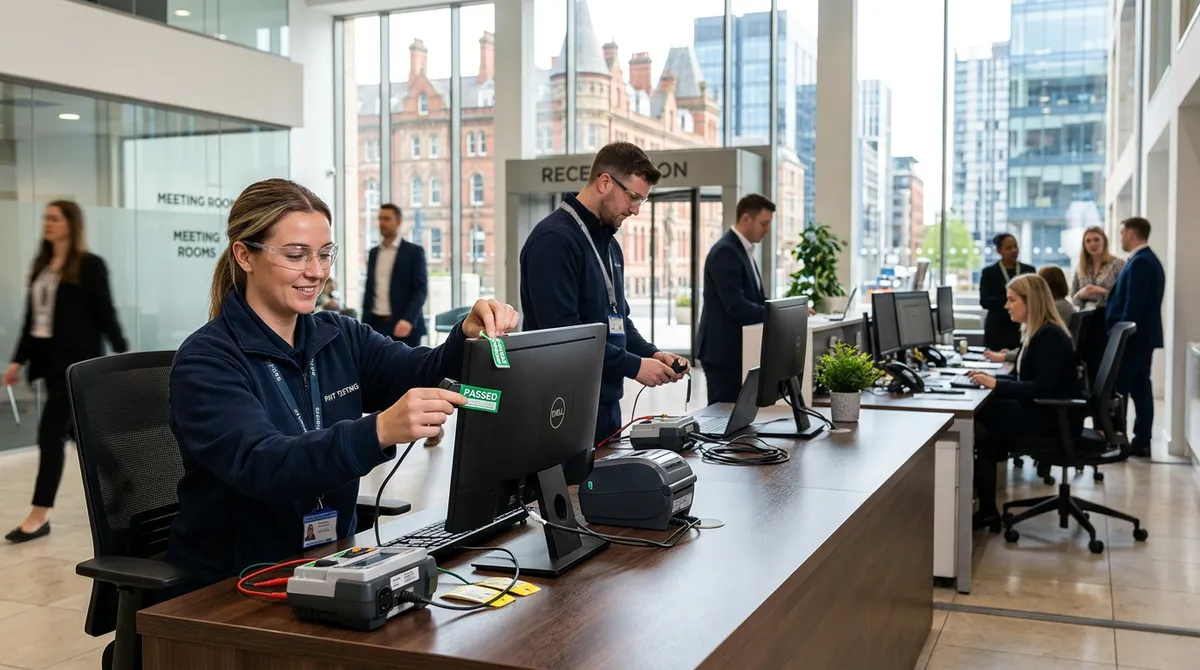
What commercial electrical testing covers
Commercial electrical testing is the umbrella term for the statutory and best-practice inspections that prove a commercial premises is electrically safe. The two core exercises are fixed-wire testing (inspection of the building’s permanent wiring, captured in an EICR) and PAT testing (inspection of portable appliances). Most commercial sites need both, on different cycles.
We deliver testing to BS 7671 (the IET Wiring Regulations) for fixed wiring and to the IET Code of Practice for In-service Inspection and Testing of Electrical Equipment (the formal name for what most people call PAT) for portable appliances.
Who this is for
- Facilities and property managers responsible for compliance across one or many premises
- Business owners and office managers receiving renewal notices from their insurer
- Landlords letting commercial property — fixed-wire testing is non-negotiable on most leases
- Contract managers preparing for an audit or tender bid that asks for current EICRs
- Procurement teams consolidating testing across a portfolio
What we test
Fixed wire (electrical installation)
- Distribution boards and consumer units
- Protective devices (RCDs, RCBOs, MCBs, fuses)
- Final circuit conductors and earthing arrangements
- Continuity, insulation resistance and polarity
- Earth fault loop impedance
- Bonding and protective conductor continuity
Portable appliance testing (PAT)
- Visual inspection of every portable appliance in scope
- Earth continuity, insulation and lead-polarity tests on Class I equipment
- Touch-current / leakage tests where appropriate
- Asset register with barcoded labelling
- Pass/fail report with date for next inspection
What you get on completion
- Electrical Installation Condition Report (EICR) with all observations coded (C1, C2, C3, FI)
- PAT register with pass/fail per asset and the next test date
- Clear remedial-works quote where any C1 or C2 is issued
- PDF copies to you, originals on file for audit purposes
- NICEIC Approved Contractor cover on the testing itself
How we minimise disruption
Testing a live commercial site means working around your operation. We will:
- Map out which circuits need isolation versus live testing before we attend
- Schedule isolations in zones for retail or 24/7 premises
- Work evenings or weekends as standard where required
- Keep a single point of contact for the duration so you are not chasing different engineers
For retail clients we treat out-of-hours testing as the default, not an upsell. See retail electrical contractor for how this works in practice.
Why use Martin Day Commercial
NICEIC Approved Contractor, CHAS, TrustMark, Part P — and the testing is signed off by a Martin Day engineer, not a sub-contracted third party. £5,000,000 public liability insurance and 30+ years of commercial testing experience across Leeds and West Yorkshire.
Related
- For the certificate alone: commercial EICR
- To put testing on a recurring cycle: planned electrical maintenance
- For emergency-lighting testing specifically: emergency lighting
- We test across Leeds, Bradford, Wakefield, Huddersfield and Harrogate
Frequently asked questions
What is fixed-wire testing?
Inspection and test of the building's permanent wiring — circuits, distribution boards, protective devices — as opposed to portable appliances. It is the same exercise as an EICR but the term "fixed-wire testing" is more common in insurance and procurement language.
How often is fixed-wire testing required?
Standard interval is five years for most commercial environments, with shorter cycles for higher-risk environments (industrial, swimming pools, theatres). We recommend the correct interval after the first inspection and record it on the report.
What is the difference between an EICR and PAT testing?
An EICR covers the fixed wiring of the building. PAT testing covers portable appliances that plug into those circuits. Both are part of a complete compliance picture; neither replaces the other.
How disruptive is testing to a working business?
Most circuits are tested live with minimal interruption. A small percentage require short isolations, which we schedule around your operations. For 24/7 premises we work overnight or in zones.
How quickly is the report issued?
Within 48 hours of completion for standard inspections. Larger multi-circuit reports are issued within five working days.